
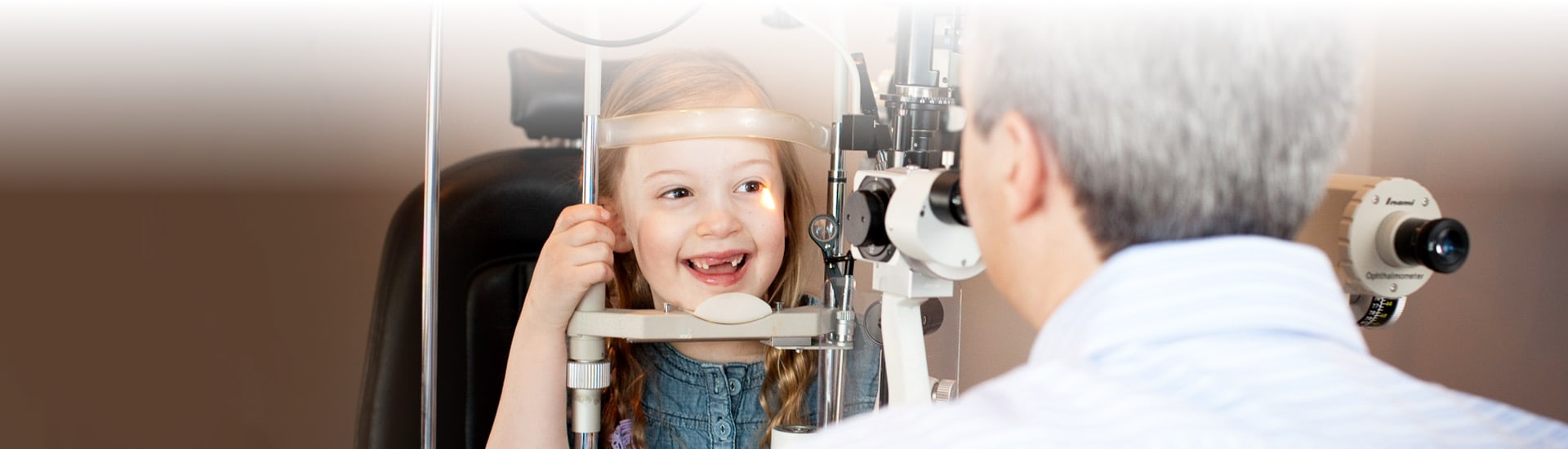
A Healthy Start for Eyes of All Ages
Even if your child is too young to read the letters on an eye chart, they still need an eye exam. Comprehensive eye exams for kids are about more than just prescribing glasses. Exams check that your child is reaching their visual milestones in a timely manner and set them up for a lifetime of healthy eyes and clear vision.
If your child is nervous about their eye exam, Dr. Abrams can help put them at ease. As the father of 2 young children, he has a relaxing and warm approach that helps little ones feel more comfortable.
Dr. Abrams is a trusted eye doctor in Woodbridge who is proud of his work with infants and children. He believes it is important to detect any vision problems before they impede a child’s progress at school. So please book an appointment to give your child’s eyes a healthy start.

How Often is a Kids Eye Exam Necessary?
Infants should have their first eye exam between the ages of 6 and 9 months and then again between 2 and 5 years. School-aged children between 6 and 19 should undergo annual eye exams—good vision is key to academic success.
We recommend that children with obvious conditions like strabismus (crossed eyes) or persistent symptoms like squinting to see in the distance have an immediate eye exam.
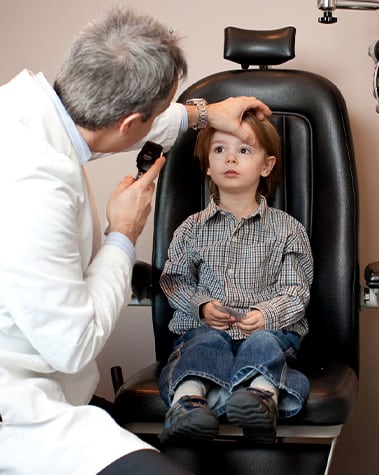
Meeting Those Milestones
By 3 to 5 months, visual skills like focusing and seeing differences between colours begin to develop. Hand-eye coordination develops a little later, between 5 and 7 months. Just before 1 year, depth perception and accommodation on objects of interest start.
By 4 or 5 years old, a child should be able to draw simple shapes and colour within the lines. If it appears any of these milestones are delayed, please book a children’s eye exam.
Poor vision in early childhood can result in delays in speech and language development. Sometimes, children with vision issues are misdiagnosed with behavioural issues like ADHD. A comprehensive eye examination can rule out a vision problem as the source of learning challenges. As your child progresses through school, look out for problems recognizing letters or numbers, missing lines of text when reading, or issues concentrating on schoolwork. These problems might indicate a vision problem.
Distinct Sight Issues Warrant Professional Treatment
Our experienced team can treat children with many different conditions, including the following:
Myopia (Nearsightedness)
If distance objects appear blurry to your child, while close-up objects are clear, they may be among the 30% of Canadians who have myopia. Also known as nearsightedness, myopia can be controlled in children if detected early.
Strabismus (Crossed Eyes)
When the eyes don’t work together, the reason may be a muscle condition called strabismus. When one eye turns inward, it is commonly known as crossed eyes. However, strabismus includes conditions where one eye turns in, out, up, or down.
The condition is usually detected in children under 6. It will not resolve on its own and requires treatment to prevent vision loss in the affected eye. That treatment may include glasses, vision training, or surgery.
Amblyopia (Lazy Eye)
A large difference in prescription between each eye can lead to amblyopia (lazy eye). This is because the brain ignores the blurry image and only recognizes the clear eye. Sometimes it is a result of strabismus. Treatment includes glasses and patching, but recovering lost vision becomes more difficult the longer it is present. When caught early and treated appropriately, amblyopia can almost always be resolved.
Convergence Insufficiency
When the eye muscles do not work together when looking at close-up objects, this may result in convergence insufficiency. This condition leads to blurry or double vision at near. Children with convergence insufficiency can have difficulty reading.
Signs You Should Book an Eye Exam for Your Child
As your children’ s eyes develop and their vision stabilizes, it’s important to keep up with regularly scheduled visits to your eye doctor in Vaughan. On average, eye exams for kids are recommended at least once a year, but if you notice any of the following signs or symptoms, it’s a good idea to book a check-in with Dr. Brian Abrams.
- Squinting or tilting their head to read
- Frequent headaches or complaints of eye strain
- Sitting very close to the TV or holding devices close to their face
- Covering one eye while reading or focusing
- Difficulty concentrating in school
- Avoiding reading or homework
- Blurry vision or double vision
- Excessive eye rubbing
- Watery or red eyes without illness
- Sensitivity to light
- Trouble with hand-eye coordination
These signs could suggest a condition that needs treatment or a need for corrective lenses. Investing in your child’s eye health sooner allows for better treatment options, better performance in school, and improved engagement in social activities, allowing for better health, growth and development.
Other signs that it may be a good time to visit Dr. Brian Abrams, a trusted optometrist in Vaughan for kids, is changing in performance at school or reports from teachers about distracted behaviour. This is a common occurrence when vision changes or refractive errors occur. Exploring options like corrective lenses and prescription glasses can make a big difference.
Book Your Children’s Eye Exam Today
Our experienced, child-friendly team can diagnose and manage vision issues, including refractive errors. We will provide a relaxed environment where your child can ask questions and feel at ease. Please book their comprehensive eye exam today.
Our Location
Where to Find Us?
We are located on the northwest corner of Hwy 7 and Pine Valley Dr.
Where to Park?
There is ample free parking available immediately directly in front of our ground floor entrance
Our Address
- 4610 Hwy 7, Suite 110
- Woodbridge, ON L4L 4Y7
Contact Information
- Phone: 905.850.2400
- Fax: 905.850.9012
- Email: info@drbrianabrams.com
Hours of Operations
- Monday: 9:00 AM – 7:00 PM
- Tuesday: 9:00 AM – 5:00 PM
- Wednesday: 9:00 AM – 5:00 PM
- Thursday: 9:00 AM – 7:00 PM
- Friday: 9:00 AM – 5:00 PM
- Saturday: 9:00 AM – 2:00 PM
- Sunday: Closed
Why Choose Us
Trusted in the Community
Dr. Brian Abrams Optometrist has been a trusted provider of family and specialized care in Woodbridge, Vaughan, for more than 2 decades. Our team has been a trusted service provider in the Woodbridge community since 1994.
Patient-Centric Approach
Your experience is our priority. From your first consultation following every subsequent visit, every member of our team is here to answer your questions and make you feel comfortable.
The Most Advanced Equipment
Our office is equipped with the best equipment and the latest technology, enabling our teams to deliver the most comprehensive and effective care, from diagnostics and exams to treatments.
Full Range of Services
We provide our customers with a wide range of high-quality and professional eye care services for every member of the family, so you can get all the care you need from one convenient location and one trusted provider.
Fast Responses
Our office is open 6 days a week and is easy to access for convenient and prompt services. We urgently respond to your requests so you can address all your eye care and optometry needs efficiently. When emergency care is required, we accommodate same-day appointments based on severity.
Expert Teams
Dr. Brian Abrams is a graduate of one of the world’s leading eye care institutions and an Ontario Association of Optometrists member. While our team has many years of education and experience, we continually participate in courses to expand our knowledge and services.



Our Brands








Our Google Reviews
Our Blog
How to Know if It’s ADHD or Vision Changes
Eye CareAttention-deficit hyperactivity disorder (ADHD) and vision changes are often confused with one another, especially in young children who exhibit the signs that overlap with both. Both ADHD and vision challenges can affect focus, ability to read, and performance in school and other programs. The overlap between symptoms can make it difficult for parents, teachers, and […]
Red Flags You Shouldn’t Ignore If You Have Diabetic Retinopathy
Diseases and DisordersDiabetic retinopathy is a condition typically diagnosed during a diabetic eye exam with your eye doctor. The condition is essentially the result of complications from diabetes, which can result in damage to blood vessels in the retina, causing symptoms such as blurred vision and floaters in the vision. Over time, diabetic retinopathy can result in […]
Read More… from Red Flags You Shouldn’t Ignore If You Have Diabetic Retinopathy
Tips for Minimizing the Impact of Screen Time on Your Eye Health
Eye DoctorScreens are virtually impossible to ignore. They’re everywhere. While it’s best to minimize screen time altogether, that’s not always a viable option. For most people, the best way to navigate the challenges of screen time is to implement strategies that help manage their screen time and its effect on their eyes. If you suspect that […]
Read More… from Tips for Minimizing the Impact of Screen Time on Your Eye Health
How to Know if It’s ADHD or Vision Changes

Attention-deficit hyperactivity disorder (ADHD) and vision changes are often confused with one another, especially in young children who exhibit the signs that overlap with both. Both ADHD and vision challenges can affect focus, ability to read, and performance in school and other programs. The overlap between symptoms can make it difficult for parents, teachers, and […]
Red Flags You Shouldn’t Ignore If You Have Diabetic Retinopathy
Diabetic retinopathy is a condition typically diagnosed during a diabetic eye exam with your eye doctor. The condition is essentially the result of complications from diabetes, which can result in damage to blood vessels in the retina, causing symptoms such as blurred vision and floaters in the vision. Over time, diabetic retinopathy can result in […]
Read More… from Red Flags You Shouldn’t Ignore If You Have Diabetic Retinopathy
Tips for Minimizing the Impact of Screen Time on Your Eye Health
Screens are virtually impossible to ignore. They’re everywhere. While it’s best to minimize screen time altogether, that’s not always a viable option. For most people, the best way to navigate the challenges of screen time is to implement strategies that help manage their screen time and its effect on their eyes. If you suspect that […]
Read More… from Tips for Minimizing the Impact of Screen Time on Your Eye Health

Check Us Out On Instagram
-
Dr. Brian Abrams Optometrist
- 4610 Hwy 7, Suite 110
- Woodbridge, ON L4L 4Y7
-
P: 905.850.2400
info@drbrianabrams.com